Tuesday, January 23, 2007

Distinguished Visitors

This week marked the 50th anniversary of the establishment of Scott Base, the main New Zealand research station located 3 miles from McMurdo. As part of the festivities, a few distinguished visitors from both New Zealand and the US were invited to come for a week or two. Scientists and staff affectionately call special visitors DVs, and they are treated to special meals, tours and helicopter flights to all of the amazing places around here. Since Lake Hoare is the main and largest field camp in the Dry Valleys, the DVs often stop to see what life is like in the field and fill up on cookies and tea. For a few hours this Sunday, we had the pleasure of hosting the Prime Minister of New Zealand, Helen Clark and her husband. There were only a few of us here, and so we actually had the chance to interact with them quite a lot. I was amazed at the contrasts between their visit and how I imagine a visit from President Bush would go. They traveled here with no secret service or even government escorts, and seemed incredibly down to earth. During lunch, I observed Helen notice a hair in her sandwich, promptly remove it and continue eating. We chatted about the science we do down here, I asked for reccommendations of hikes to do in New Zealand, and we talked about human health sociology (her husband teaches at a university in Aukland). All in all, it was a great visit. Also on this trip were a few of her cabinet members and from the US, the head of the National Science Foundation.

The Prime Minister of New Zealand, Helen Clark, and her husband at Lake Hoare Camp

Also in town for the anniversary was Sir Edmund Hillary, the New Zealand mountaineer who was the first person to climb Mt. Everest. He is in his eighties now, and doesn’t get around extremely well so we didn’t expect to see him. Last night when we were back at F6, we found out he was scheduled to stop at Lake Hoare today and so we hiked 4 miles over the glacier to come see him. It was unclear as to whether they would stop because it was the last event in a long day and he gets tired very easily. He even has his own doctor traveling with him. We made it to Lake Hoare in time to find out that they were indeed stopping, but only briefly. The six of us that were here brought tea and scones out to the helicopter for him, the pilot and the 5 other Kiwi DVs. It was a wonderful visit. Sir Ed stayed in the helicopter seat but shook all our hands and took a group picture with us. Everyone else got out and milled around for 20 minutes or so. I got a chance to talk to him, his son-in-law and one of the pilots that was the first to fly in Antarctica- boy was he a riot! Sir Ed has been to and worked in Antarctica before, and was actually the first to drive a Caterpillar to the South Pole! I feel pretty lucky to have met him- definitely worth the hike over, even for just 20 minutes!

Sir Edmund Hillary and the Lake Hoare crew.

Sunday, January 14, 2007

Stream Algae

Green and Orange stream algae

The most abundant life we see in the Dry Valleys is the stream algae. They come in a few different colors: orange, red, green and black. All of these live in and around the streams and each color has a different niche. For example, black algae look sort of like mosses and grow in the wetted zone next to the stream, while orange algae like to grow in mats on top of rocks in the stream bed. A really neat thing about the algae is that over winter when the streams dry up, they enter a biological state called anyhdrobiosis. Basically this is like freeze drying. Their tissues dry up and shrivel, but soon after they are exposed to water again they resume normal functioning. Studies have shown that the re-hydration process can happen fully within a few hours. The algal mats are made up of various single-celled and colonial organisms, mostly cyanobacteria (prokaryotic “blue-green” algae) and diatoms (silica-walled eukaryotes). My fellow stream team member Lee is doing her PhD project on the algae and trying to develop a technique to more easily identify the diatoms using their DNA and RNA.

Monday, January 8, 2007

Penguin Update

A day after the first sighting, we flew over Lake Fryxell and saw the penguins almost to the west shore, farthest away from the ocean. Hard to watch. The next two days after that though, we only saw one penguin. I don't know whether this penguin was the leader or a defector, but the other 5 were nowhere in sight. The good news is that this one was decisively headed back towards the ocean, and we observed it in front of F6, where we originally saw them, heading east. We didn't bother it and haven't seen it since. It's been 3 days, hopefully it is swimming in the ocean and eating it's fill. I can only hope that the other 5 were ahead of it!

Thursday, January 4, 2007

Penguins

Yesterday was the best day and the saddest day all in one. Pete, Lee and I were just getting our day started and it was gorgeous weather! The morning was pretty warm and a few streams started flowing, so we had a lot in our plans. As we turned to go down the lake, I noticed that what I thought to be a shimmery mirage on the ice was actually a little penguin! It was pretty far off but waddling towards us…my first emotion was excitement- I was afraid that I would leave Antarctica without seeing one! Then I realized that any penguin that had made it over the sea ice and 6 miles over land to end up at Lake Fryxell was doomed to become one of the mummified relics that we come across on our hikes. As we walked towards it, I noticed FIVE other penguins a few hundred yards away. They were all Adelies, known for being the small, playful species of penguin. It is very rare to see more than one stray penguin in the Dry Valleys. In this case it appeared that the small one I saw at first was the leader and had lead them all astray.


I knew that we wouldn’t be able to rescue them, and that the rules of the Antarctic Treaty forbid interfering with wildlife, but it didn’t stop me from wanting to feed them and corral them back to the open water (probably over 15 miles away)! We did notify the penguin researcher in McMurdo via radio, and he asked us to look to see if their wings were tagged and write down the numbers (they weren’t tagged). As we watched and took pictures and their personalities became more evident, it was harder and harder to come to grips with the fact that they were on their death march.


After a good photoshoot, we had to get on with our day. We left hoping that for some unknown reason they would turn around, but knew it wasn’t probable. When we returned to F6 for the evening, we saw that they were a mile further inland than when we saw them in the morning. Mummified penguins have been found all the way up past Lake Bonney which is 15 miles away. So it is feasible that they still have a long journey ahead of them. Thinking about it is heartbreaking!

Monday, December 25, 2006

Holidays

At large holidays like Thanksgiving and Christmas, most of the people working in the Dry Valleys gather at the central field camp, Lake Hoare. The camp manager Rae plans elaborate meals and activities. For Thanksgiving this year, we had a full dinner- better than most have at home! There were 8 pies for dessert. For Christmas/Hannukah/Solstice Rae cooked roast beef, baked veggies, mashed potatoes, asparagus, baked pumpkin and bread pudding.

It is a tradition for Santa to visit the field camps in the Dry Valleys and bring mail and packages from town. The head National Science Foundation representative for Antarctica traditionally dresses as Santa, and he has just the grey beard for the job. There are also elves! It is a real treat to get to be an elf, and the roles are reserved for people that have worked at McMurdo station for years but haven’t gotten to see the beautiful Dry Valleys yet. The smiles and looks of awe on their faces really reminded me how lucky I am to have this experience- many people would give a lot to do what I do every day!
Santa disembarking from his updated sleigh

This year, 15 people gathered at Lake Hoare for the Christmas weekend and we celebrated the holidays on Dec. 24th. During the day everyone was busy decorating hundreds of gingerbread and sugar cookies using homemade icing of various colors. The big event was the construction of the gingerbread house, complete with stained glass windows, a working chimney and candles inside. After dinner we had the traditional Lake Hoare gift exchange. Everyone who comes for the holidays brings a wrapped present. One person starts the game by picking a present at random and unwrapping it. The next person can either steal the first gift (in which case the first person goes again) or pick another wrapped one. The game proceeds like this until everyone has a gift. This year, gifts ranged from fancy maps of the area to DVDs to chocolate to hand-knitted hats. I happily ended up with some Antarctic hot sauce and matching t-shirt. The assistant station manager, Sandra, strategically stole my gift (a journal I covered with a collage about Antarctica) from another woman late in the game. I would say everyone was happy with the way things ended. The night culminated by transforming the hut into the “Velcro lounge” by securing black fabric over the windows to simulate night. After a dance party, everyone retired to their tents and enjoyed sleeping in the next morning.

The gingerbread house!

Tuesday, December 19, 2006

Helicopters

Besides hiking, helicopters are the main way we travel around the Dry Valleys. The US Antarctic Program and the National Science Foundation handle the helicopters as a service for all scientists down here, who pay for the helicopter hours with grant money. There are 4 US helicopters in use: 2 small A-Star models that can accommodate up to 5 passengers (with limited gear), and 2 larger Bell-212 models that can carry 10 passengers or a lot of gear. The Bell-212s have a helitech on board that serves as a co-pilot and helps with on and offloading gear. This is a complicated process because weight distribution has a great effect on the safety of the flight as well as the amount of fuel used. Since our group is small and we generally don’t have to transport a lot of weight in gear, the stream team usually rides in the A-Star models. These helicopters are special because it is just you and the pilot and one person gets to ride in the front passenger seat (where the helitech would normally sit). This is where you get some of the best views of the scenery!
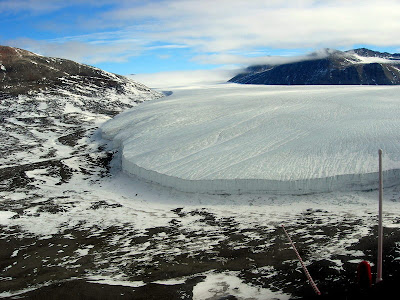
View of the Commonwealth Glacier from an A-Star helicopter's front seat

Before anyone gets to ride in a helicopter, you must go to a class that teaches you how to fasten the complicated seatbelts, how to act/load gear on a helicopter when the rotors are turning, and what to do in case of an emergency. Before you depart McMurdo, a helitech gives another short lecture about how to weigh and label your gear and how to pick a helmet that fits properly. The sound of an operating helicopter (especially a 212) is deafening and helitechs encourage the use of earplugs because it cuts down on the sense of hurriedness that you get when working around helicopters. Good luck trying to sleep in if helicopters are in the area!

Offloading a Bell-212 when the rotors are turning

The helicopter pilots come from all over (the states, England, Bulgaria, etc) and we’ve gotten to know them all. Some have been coming down to fly here for years. There are 6 or 7 of them that rotate doing day flights and evening flights. They are all interested in what we do, and will do their best to help you out by flying over a stream you’re surveying, or trying to land as close as possible to your destination. Mostly they just enjoy flying the helos (as they’re called down here) and if they have extra time you get to play around a bit.

Riding in one of these machines is fascinating. Instead of creating pressure differences to generate uplift like fixed-wing aircraft, the helicopter’s rotors beat the air into submission through much more complicated physics, allowing the pilot to hover. This feature makes it easy to land in tight spots and most importantly allows you to do some neat sightseeing because you can go slow without losing altitude.
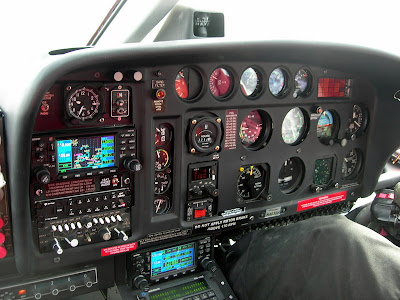
The instrument panel in an A-Star


Both the A-Star and Bell-212 helicopters can transport a lot of weight by something called a sling load. This is basically a net attached to a cable that is hooked onto the bottom of the helicopter. Most of our fuel drums get out to camp this way. The loads have to be pretty heavy (at least 700 lbs) or they can bounce up or get blown into the rotors! This was the cause of the most recent (2003) helicopter crash in the Antarctic.

Pilot Marco in an A-Star helicopter delivering a sling load to F6 camp

Tuesday, December 12, 2006

Unique Antarctica

Just walking around the Dry Valleys you may stumble (literally and figuratively) upon many interesting wonders of nature. Here are a few examples:

Mummified seals and penguins: Carcasses of seals and penguins have been found in the Dry Valleys over 30 miles away from the sea. This is not the result of a sea level drop, but simply because the seals and penguins have “lost their way.” Scientists say that when seals travel, some follow cracks in sea ice that lead them far from open water. When winter comes and they are far from open water, they become extremely stressed, perhaps causing their navigational systems to deteriorate. At this point, seals either try to return overland before winter sets in or share a breathing hole in the ice created by another seal. Often the seals choose the former and cannot find their way back, ending up in the Dry Valleys and other areas. The seals and penguins appear to be in pretty good shape but this can be very misleading because some are hundreds of years old. The very dry, cold weather makes it hard for any organic material to break down (this is also why prevention is the best remedy for pollution in the Dry Valleys).
One of the many mummified seals you may find in the Dry Valleys. I think this one is a Leopard Seal.
Kenyte: Kenyte (a type of phonolite) is a volcanic rock type found only in Antarctica and Kenya. It is so rare because it contains minerals that do not usually occur together. The kenyte in Antarctica comes from Mt Erebus, 20 miles from McMurdo station. The heat in the caldera of this volcano is not uniform, causing differing viscosities and temperatures within the same lava body. These varying conditions allow several families of minerals to form in an environment that would normally support only one type.

Kenyte. The lenses are made of a mineral called microcline.

Ventifacts: A ventifact is a rock that has been sculpted by the wind. Wind speeds get so high in Antarctica (especially in the winter) that large sediment particles become entrained and effectively sandblast a regular piece of granite or other rock into an abstract sculpture. The largest and most stunning of these ventifacts can be found on high ridges where the wind whips through notches.

One of the many ventifacts on a high ridge. We found some that were 5 or 6 times as large as this one.

Blood Falls: You can only stumble across this one if you’re not looking very closely. Blood Falls is an outflow of subglacial water at the terminus of the Taylor Glacier in the Taylor Valley. The researchers studying this landform believe that a large quantity of iron-rich seawater became trapped in the glacier, part of which is released and oxidized each year. This creates a striking frozen waterfall that looks like the glacier is bleeding.

Blood Falls emerging from the Taylor Glacier. Lake Bonney is in the foreground. The glacier face (not including the brown sediment) is about 50 feet high.